The State Legislative Battle Over AI Infrastructure
This post is on my substack techno-statecraft: here.
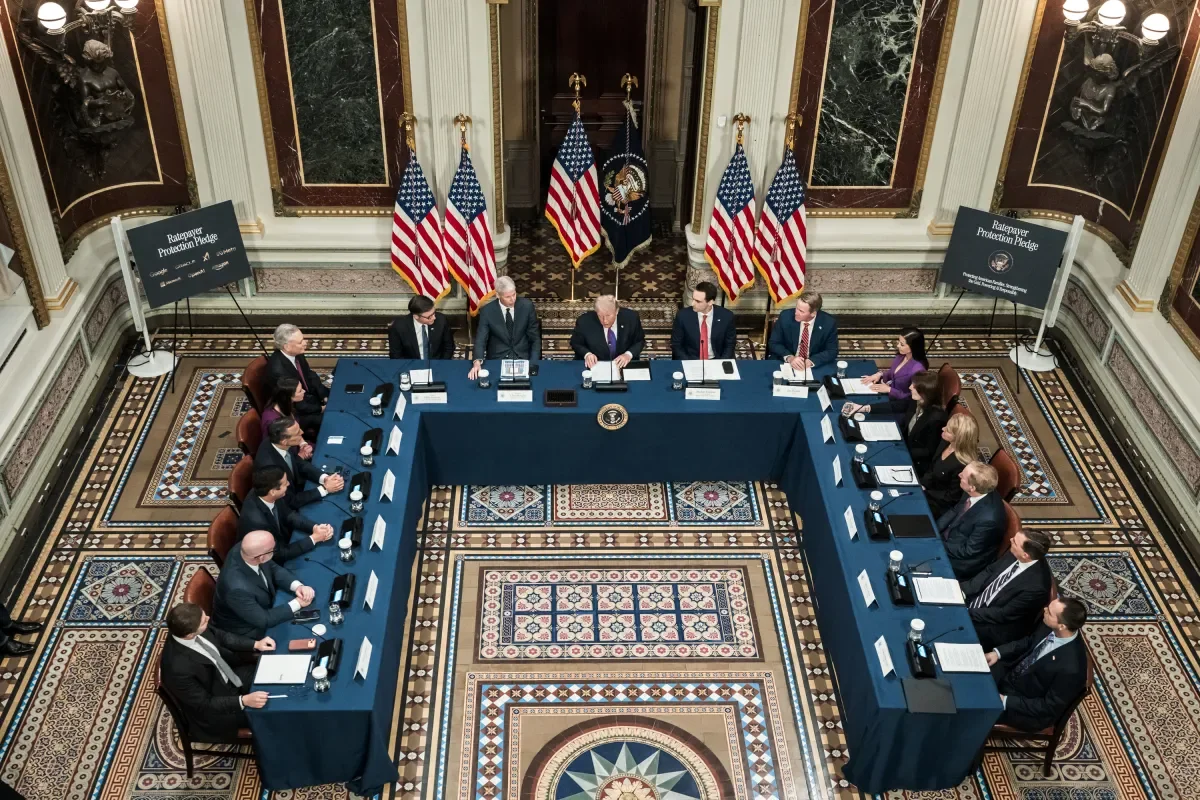
“President Donald J. Trump participates in a Ratepayer Protection Pledge roundtable” at the White House, 2026. Source: The White House.
For more than a decade, states competed for data centers with tax abatements, sales tax exemptions, expedited permits, and infrastructure promises. That incentive model is now facing pressure. Across more than 500 data center bills introduced over the past two years, lawmakers have begun to move from open-ended subsidy toward ratepayer protection, water oversight, transparency, environmental review, and moratoria. The shift is real but uneven. Legislatures increasingly recognize the costs of hyperscale expansion, yet the strongest rules still rarely survive. Data center operators continue to secure public support while avoiding firm obligations to pay for the grid, water, land, and public infrastructure their growth requires.
In March 2026, Amazon, Google, Meta, Microsoft, OpenAI, Oracle, and xAI gathered at the White House and signed the Ratepayer Protection Pledge. The companies promised to cover the cost of new electricity infrastructure for their data centers, so that American households would not pay for the grid expansion driven by AI.
Within weeks, Maryland filed a complaint with federal energy regulators. The state argued that its residents were being charged roughly $2 billion in grid upgrade costs tied to data centers across the border in Virginia. West Virginia ratepayers faced a similar problem: more than $440 million in transmission infrastructure costs built largely to serve those same Virginia facilities, with no clear mechanism to contest the bill. Ari Peskoe, director of the Harvard Law School Electricity Law Initiative, described the pledge bluntly: “The ratepayer protection plan is a show designed to sweep this issue under the rug and show the White House has solved the problem.” Emily Peterson-Casson, policy director for Demand Progress, called it a set of “worthless pinky swears” from corporations trying to push the burdens of AI expansion onto the public.
The problem was not only bad faith. As Latitude Media observed, the pledge was redundant where protections already existed and unenforceable where they did not. It relied on tariff negotiations, utility regulation, and state-level decisions that a White House proclamation cannot direct. Its rapid failure exposed a structural mismatch: the federal government announced a solution to a conflict taking shape inside state utility commissions, legislatures, zoning boards, and regional grid-planning processes.
In this article, I look at that state-level terrain. Over the past few months, I’ve compiled hundreds of data center bills from the past two years to see what has passed, what has stalled, and why the strongest rules remain so hard to enact. The picture is not one of state inaction. Regulation is moving, but unevenly, and often too late: after costs have been allocated, infrastructure commitments made, and communities denied the information they need to challenge projects before approvals harden.
A decade of incentives gave way to something nobody planned for
States spent roughly a decade competing for data centers. The instruments were tax exemptions, streamlined permitting, bond financing, and what amounted to unconditional subsidies. The Data Center Coalition, the industry’s primary advocacy group, circulated a justification that worked reliably in state capitols—“9 in 10 data centers would not have been built where they were had it not been for the tax incentives”—and legislatures accepted a premise that made the deal look clean.¹ Data centers brought capital without asking much back. They built on industrial land, employed relatively few permanent workers, and at the scale of the early 2010s, their electricity demands were manageable.
All three of those assumptions have since collapsed. A hyperscale data center can now draw 100 to 500 megawatts continuously—equivalent to a small city—and the concentration of them in places like Northern Virginia has begun reorganizing regional electricity markets in ways that no state planner appears to have anticipated when the incentive era began. A Gallup poll found that seven in 10 Americans oppose data centers in their area.
The legislative response has been extraordinary. I’ve tallied up legislation from the end of the 2024 legislative session and the current one from 2025 to 2026.² Across 48 states, from 2024 through 2026, legislators introduced no less than 548 bills governing data centers—more legislation on a single industrial type in two years than most people expected to see in a decade. The bills cover electricity rates, water use, transparency requirements, permitting reform, tax incentive continuation, zoning preemption, and outright bans on new construction. Something has clearly shifted in the political assessment of what data centers are.
The composition of legislation tells the story most directly. In 2024, 58% of all state data center bills were tax incentive bills—the inherited instrument of the prior decade. By 2026, that share had fallen to 14.9%. Bills targeting electricity rates and ratepayer protection climbed from 5% to 11.7% over the same period. Transparency and disclosure bills went from 1.7% to 25%. Water use bills went from 12% to 24%. 21 bills in 2026 propose outright moratoria on new facilities in states that two years earlier were competing to attract them. The original deal—subsidize the buildout, ask no questions—has clearly lost its political consensus. Whether it has produced enforceable regulation is a different question.
Bills that would actually bind industry keep failing
The gap between bills introduced and bills enacted requires some care to read correctly. The raw numbers are large enough to suggest regulatory momentum that the enacted record simply does not support.
Across 250 inactive bills, incentive legislation passed at roughly 30%, while protective legislation—bills targeting ratepayer costs, transparency requirements, environmental reviews, and moratoria—passed at 23%. Incentive bills therefore advanced at a modestly higher rate: about seven percentage points higher, or roughly 30% higher in relative terms. This difference appears across partisan environments and bill mechanisms, though the margin varies by context.
The content of enacted legislation makes the gap clearer. Of 92 enacted bills across two years, 31 were coded as grid and energy supply measures, representing 34% of enacted legislation; 26 were tax incentive bills, or 28%; and only 5 required transparency or disclosure of resource use, or 5%. Even the rates and affordability bills that became law often stopped short of direct cost-shifting protections. Alabama authorized its Public Service Commission to review utility contracts; California directed its utility regulator to assess cost-shifting and report to the legislature; South Dakota allowed its PUC to assess actual costs; and Virginia required its State Corporation Commission to determine whether non-data center customers are subsidizing data center customers. These laws open regulatory inquiries, but they do not require a specific outcome.
The moratorium story is the sharpest version of this pattern. Of 21 state moratorium bills introduced, 19 have stalled in committee, one died in Wisconsin, and one—Maine’s LD 307—passed the legislature only to be vetoed by Governor Janet Mills in late April 2026. Mills said she supported a temporary moratorium in principle but vetoed the bill because it did not exempt a specific redevelopment project in Jay that had broad local backing. The legislature then failed to override the veto. Wisconsin also had a failed statewide mortarium, despite many local ones in place. Zero moratorium bills have been enacted at the state level anywhere—including in Maine, the only state whose legislature passed one. North Carolina, Ohio, Indiana, and Michigan all have many local data center moratoria, but they have not moved a single bill to a floor vote.
On transparency: counting every bill containing disclosure language in any form, 116 qualify. While 74 are still considered “active,” only 5 have passed—3 are water reporting requirements, 1 is a municipal tax disclosure rule, and 1 is California’s cost-shifting study.
Colorado illustrates the dynamic in concentrated form. During the 2026 session, 196 individual lobbyists representing 150 clients registered positions on data center legislation, making the bills among the most heavily lobbied measures in Denver that year. A bill that would have required real-time renewable energy matching and full operator responsibility for new grid infrastructure costs failed. An industry-backed bill creating a new Data Center Authority also failed. Colorado ended the session with nothing enacted. California’s legislation was stripped back to a CPUC study of cost-shifting. Florida even removed NDA transparency language from a bill before passage.
It is tempting to read this as industry winning every fight. Bills that support development, streamline permitting, or continue incentives (28% pass rate) move more readily than bills that impose disclosure (5% pass rate), moratoria (0% pass rate), or binding cost-allocation obligations. Industry does not need to win every legislative fight. It needs to block or weaken the measures that would force operators to pay for grid upgrades, disclose resource demands, or give communities enough information to contest approvals. That differentiation, visible across two years and many state contexts, marks the difference between a general policy debate and a coordinated struggle over the terms of data center expansion.
Costs are landing before regulation can catch them
In Virginia, the pattern is clear enough to appear on monthly electricity bills.
Dominion Energy serves roughly 450 data centers in Northern Virginia, the world’s largest data center market. Under some scenarios, the state’s electricity consumption could nearly triple over the next 15 years, driven largely by that demand. In November 2025, the State Corporation Commission approved a Dominion rate case that added $11.24 per month to residential electricity bills in 2026, followed by another $2.36 in 2027. At the same time, the SCC created GS-5, a new rate class for customers using more than 25 megawatts, including data centers. The class requires higher minimum payments meant to limit future cost-shifting. It takes effect in January 2027.
The timing matters. Residential customers felt the rate increase immediately. The mechanism designed to prevent similar cost shifts arrives two years later, while the harder distributional questions move to the next rate proceeding. Clean Virginia said the SCC had “punted on data center costs.” The phrase captures the problem. This is not corruption or regulatory failure in the narrow sense. It reflects how utility proceedings often defer conflict until the economic relationships producing that conflict have already entrenched themselves.
Then-Governor Glenn Youngkin vetoed a bipartisan bill in May 2025—SB1449/HB1601—that would have required noise and environmental impact assessments for large facilities and allowed local governments to require site assessments covering water, agricultural resources, and historic sites. Youngkin argued that the bill imposed a “rigid framework that could chill investment and hinder economic development.” He left office in January 2026 and was succeeded by Governor Abigail Spanberger, who had campaigned on energy affordability and the claim that data centers should pay their fair share. Yet her first legislative session on this issue showed how these structural constraints can outlast any single governor. Spanberger amended rather than vetoed data center cost-shift bills, but critics argued that her amendments replaced explicit cost-allocation requirements with softer regulatory guidance, weakening the bills in the process. The governor changes; the deferral continues.
Below the legislative fights sits an information problem that is less visible but just as consequential. Virginia Mercury reporting found that 25 of 31 Virginia localities signed non-disclosure agreements with data center developers—agreements that prevent communities from accessing load forecasts, water demand projections, and infrastructure cost estimates for proposed facilities. The NDAs suppress the information residents need to organize early enough to influence approval decisions. By the time communities know enough to contest a project, the key entitlements have often already been secured.
Maryland’s FERC complaint extends this picture across state lines. Grid infrastructure built to serve Virginia data centers can generate transmission costs that flow to Maryland and West Virginia ratepayers through regional allocation mechanisms those states cannot unilaterally change. That is exactly the kind of cost shift the Ratepayer Protection Pledge was supposed to prevent. The complaint suggests it was already happening before the pledge was signed.
The protection that passed did so before markets became too dense
There are real counterexamples, and they’re important precisely because they show the conditions under which protective legislation can pass. The finding is more complicated than a simple story of industry dominance.
Minnesota enacted the strongest ratepayer protection law of any state. HF 16, passed in a June 2025 special session on an 85–43 House vote and a 40–26 Senate vote, was sponsored by a Republican. The law directs regulators to create a separate rate class for large data center customers, require them to pay the full cost of service without cross-subsidization from other ratepayers, protect households from stranded asset risk if a data center exits, and ensure that electricity serving data centers complies with the state’s renewable energy standards. It also assesses each large qualifying facility $2–5 million annually for home weatherization for income-qualified residents. The Citizens Utility Board, which spent months building the legislative coalition before the session opened, described the law as “nation-leading.” The statute is in effect, though its central rate-class provisions still depend on PUC implementation.
Other states moved in similar directions. Oregon’s POWER Act, signed in August 2025, directed the state PUC to create a separate rate class for facilities above 20 megawatts and require large operators to bear the grid costs their load creates through long-term service commitments and cost-allocation rules. Utah modified the utility duty to serve for large loads, allowing utilities to require operators to secure their own energy supply when new demand would otherwise require major infrastructure investment. Texas, working through ERCOT’s distinct grid structure, required large facilities above 75 megawatts to pay interconnection study fees and meet new financial and operational requirements before connecting to the grid.
These are real protections. They also passed under conditions that differ from Virginia’s. Oregon and Minnesota had organized ratepayer coalitions with legislative relationships built over years, not months. Texas routed much of the cost-allocation question through interconnection rules rather than a direct legislative fight over utility tariffs. Minnesota had no Dominion equivalent: a single utility so central to the state’s energy economy that its rate cases have become inseparable from the politics of data center expansion.
The sharper point is not that protections pass only in low-density markets. Oregon and Texas already face significant data center pressure. The point is that binding protections become harder to impose once data center load is deeply embedded in utility planning, local fiscal dependence, and statewide economic-development politics. By the time a state hosts hundreds of data centers and faces a projected doubling or tripling of electricity demand, the leverage to impose cost allocation on the industry driving that demand may have already shifted.
That leaves a genuinely open question. Across 49 states, 299 bills remain active.² Utility commission proceedings in Virginia and California remain open, and Maryland’s FERC complaint on cross-state transmission cost allocation is unresolved. Senator Marsha Blackburn has released a federal framework to codify the pledge’s ratepayer-protection principle, but it has not yet advanced as binding law. The tariff negotiations that would implement what the pledge promised are happening, or failing to happen, through separate state regulatory processes. Whether any of this closes the gap between what legislators introduce and what regulators must enforce remains unsettled, jurisdiction by jurisdiction and docket by docket.
References
¹ Brookings Institution, “New evidence on data center employment effects” (2025), found that naive employment estimates—which fail to account for preexisting growth trends—overstate data center job creation by a factor of three. Even setting aside the employment debate, the question of who pays for grid infrastructure is distributionally independent of how many jobs a facility creates.
² Kollar, Justin. 2026. “Data Center-Related State Legislation, 2024–2026.” Harvard Dataverse. https://doi.org/10.7910/DVN/XXFGD9.