Turtle Mountain Community
*Winning entry for the Turtle Mountain Housing Competition
Competition, 2015
Team: Chris Reznich, Justin Kollar
Description: The competition brief called for a proposal for a housing prototype for the Turtle Mountain tribe in North Dakota. The tribe has had bad experiences with modular housing in the past, and seeks a proposal that is sensitive to its needs. People within the tribe live in a precarious position, economically disadvantaged, and call home an unforgiving environment. In the winter, multiple families often share dwellings for warmth and to save on energy costs.
Proposition: Our proposal calls for more than just a house, but an integrative solution that combines the house with a ‘hoop house:’ a greenhouse-like structure that acts as a heat sink and provides heat throughout the winter offering passive strategies that minimize cost, and an expansive strategy to provide a means for food cultivation and job creation, allowing for a lightening of a significant element of the tribe’s economic precarity. The strategy also takes into account the local ecological context, situating the settlements in areas with little damage to the environment while also taking advantage of superior areas for solar gain. As the houses and hoop houses aggregate, they create communities from block formations. The hoop house becomes the foundational connector of neighborhoods. Originally employed for purely horticultural ends, the thermal modulation can be employed to accommodate innumerable additional communitarian programs. While basic horticultural function scales from single-kitchen vegetable gardens or a grandmother’s flower bed up to production of boutique, value-added goods, the flexible, semi-conditioned interior can be appropriated as cafes, sports fields, swimming pools, indoor parks, etc. Thus, the system can simultaneously provide healthy, fresh produce and free space for an active lifestyle to the larger Turtle Mountain community all throughout the winter.
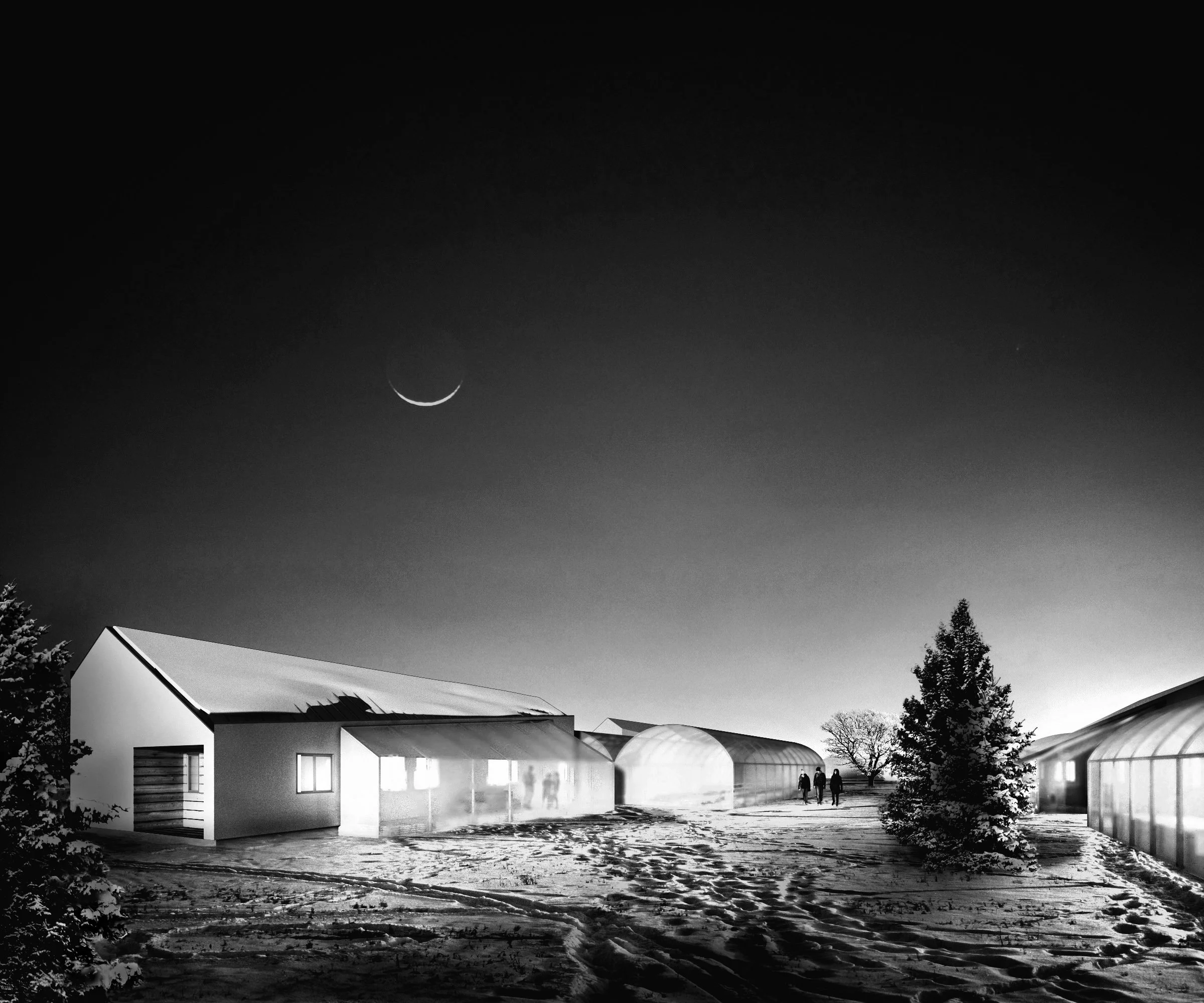
Rendering of Housing Prototype and Hoop-house Module
As the primary shelter for the family, the house is also the foundation for productive life. In caring for one’s beloved, the house becomes the home - a sanctuary for belonging and an expression of identity. Yet, rich civic life requires an extension of the independent life beyond the home. In an effort to accommodate this extension, we propose the addition of a hoop house - a simple yet underutilized environmental technology.
As an historical cold-climate adaptation, hoop houses use inexpensive and easy-to-find materials to trap heat from solar radiation and slowly release it through cold nights, thus moderating temperatures and extending growing seasons. Consisting simply of a thick plastic film stretched over a modular skeleton and any high thermal mass material (water, vermicompost [exothermic!], and simple biomass are most common), hoop houses are easy to construct, deconstruct, reconfigure, reuse, and recycle. Though virgin plastics have a high embodied energy, the low energy cost of recycling dramatically reduces this value over total lifespan.
By coupling the hoop house with a heat exchanger in the prototype wall system, excess heat that would typically be vented to the environment can be harvested in order to raise ambient temperatures in the home, reducing the length of time the home requires active heating. Hay bales, used both as biomass in the hoop house and as a primary insulating material within the prefabricated timber-frame wall unit, becomes a dynamic material. As the site can supply large quantities of hay locally, the material is integral to the entire system. The repeatable wall unit, assembled almost exclusively from materials available on or near the Reservation, becomes a building block for multiple variations of housing forms and extended family arrangements.
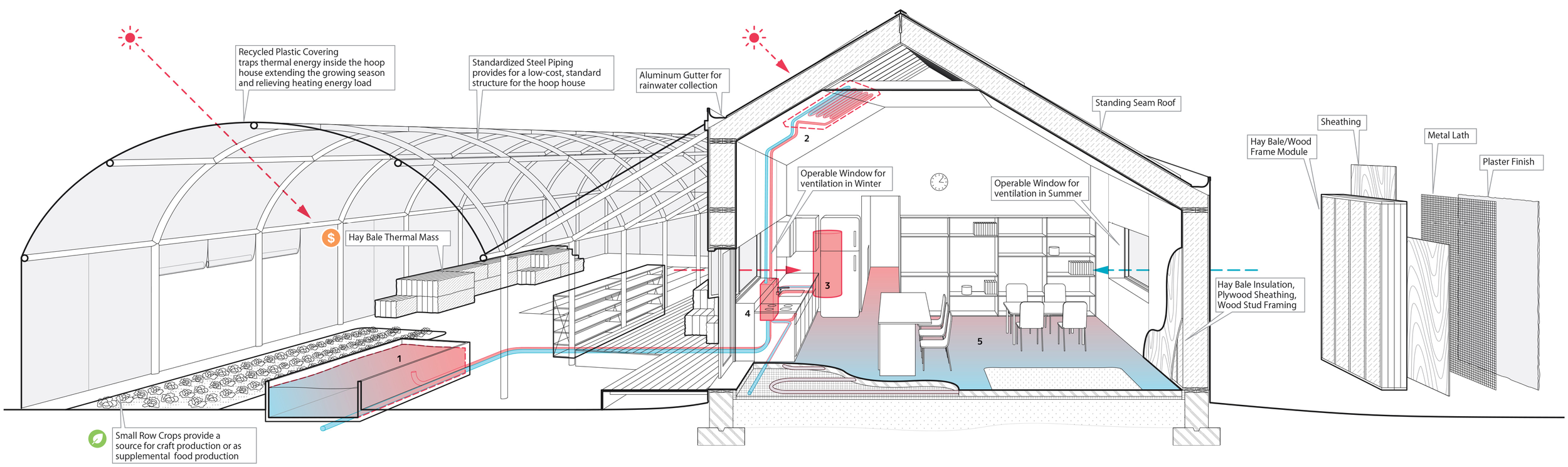
Exploded Axonometric Diagram of Primary Elements of Infrastructure
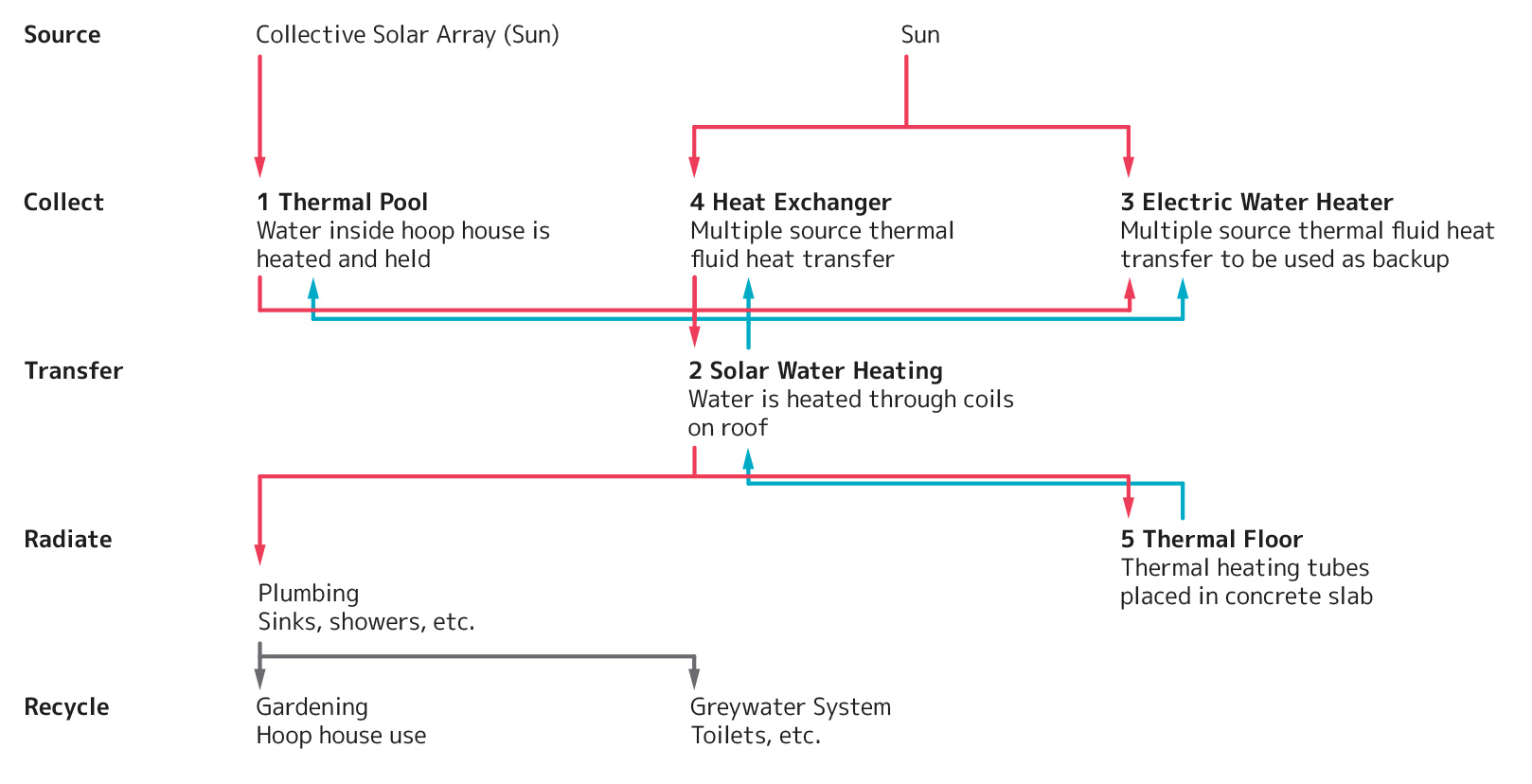
Thermal Energy Circuit Diagram
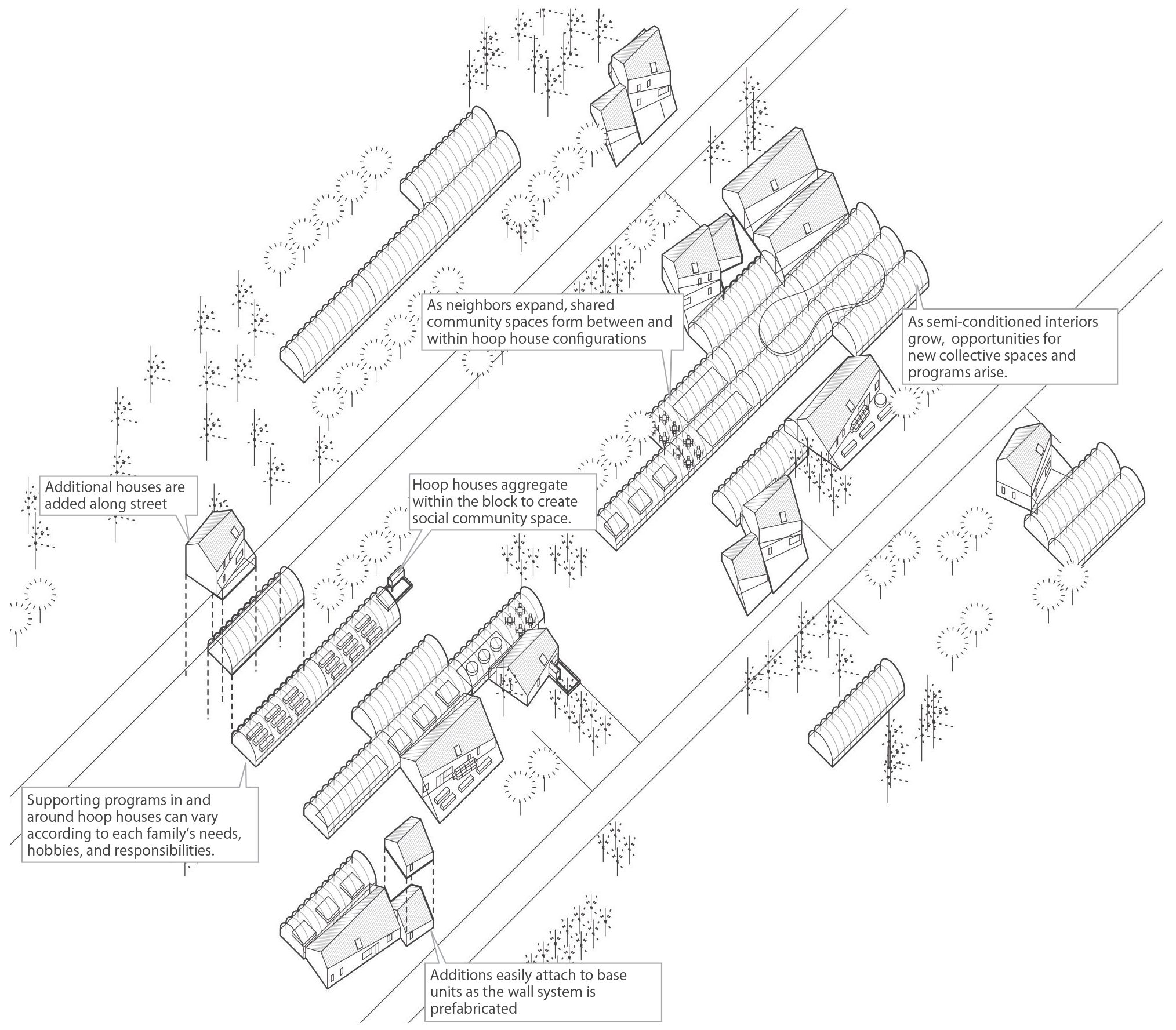
Unit Aggregation and Community Formation Diagram
As the houses and hoop houses aggregate, they create communities from block formations. The hoop house becomes the foundational connector of neighborhoods. Originally employed for purely horticultural ends, the thermal moderation can be employed to accommodate innumerable additional communitarian programs. While basic horticultural function scales from single-kitchen vegetable gardens or a grandmother’s flower bed up to production of boutique, value-added goods, the flexible, semi-conditioned interior can be appropriated as cafes, sports fields, swimming pools, indoor parks, etc. Thus, the system can simultaneously provide healthy, fresh produce and free space for an active lifestyle to the larger Turtle Mountain community all throughout the winter.
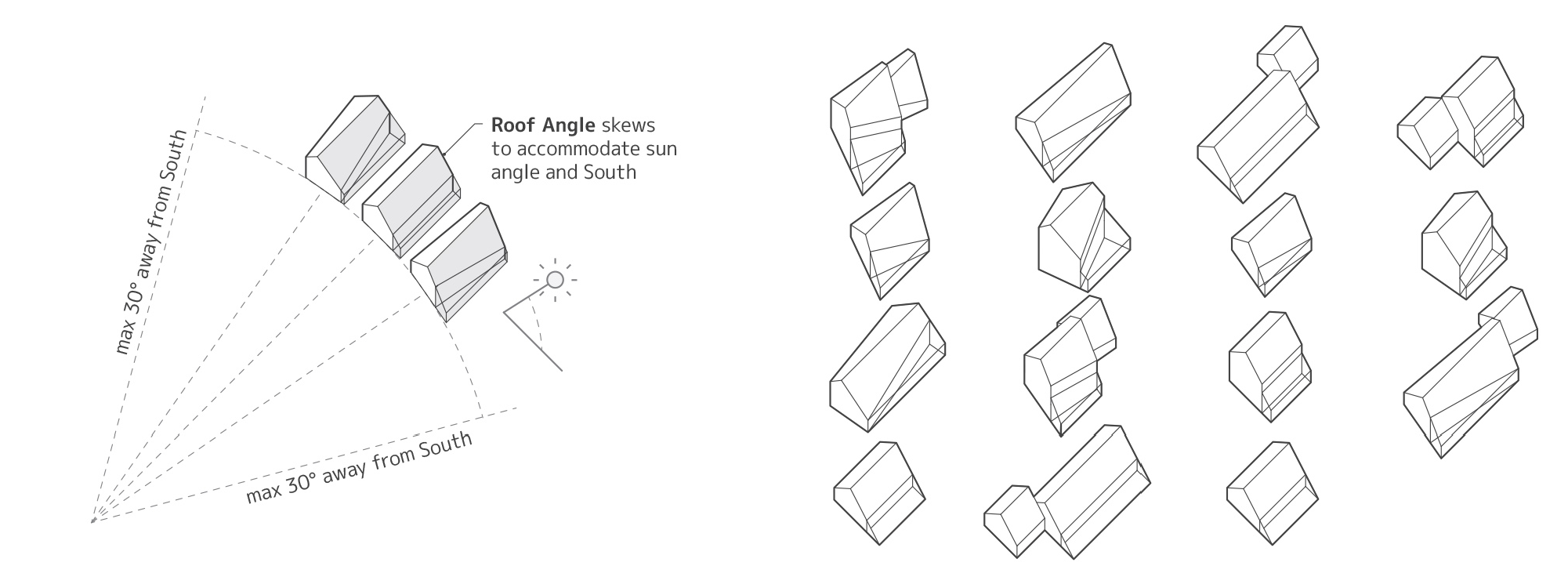
Roof Articulation and Unit Combination
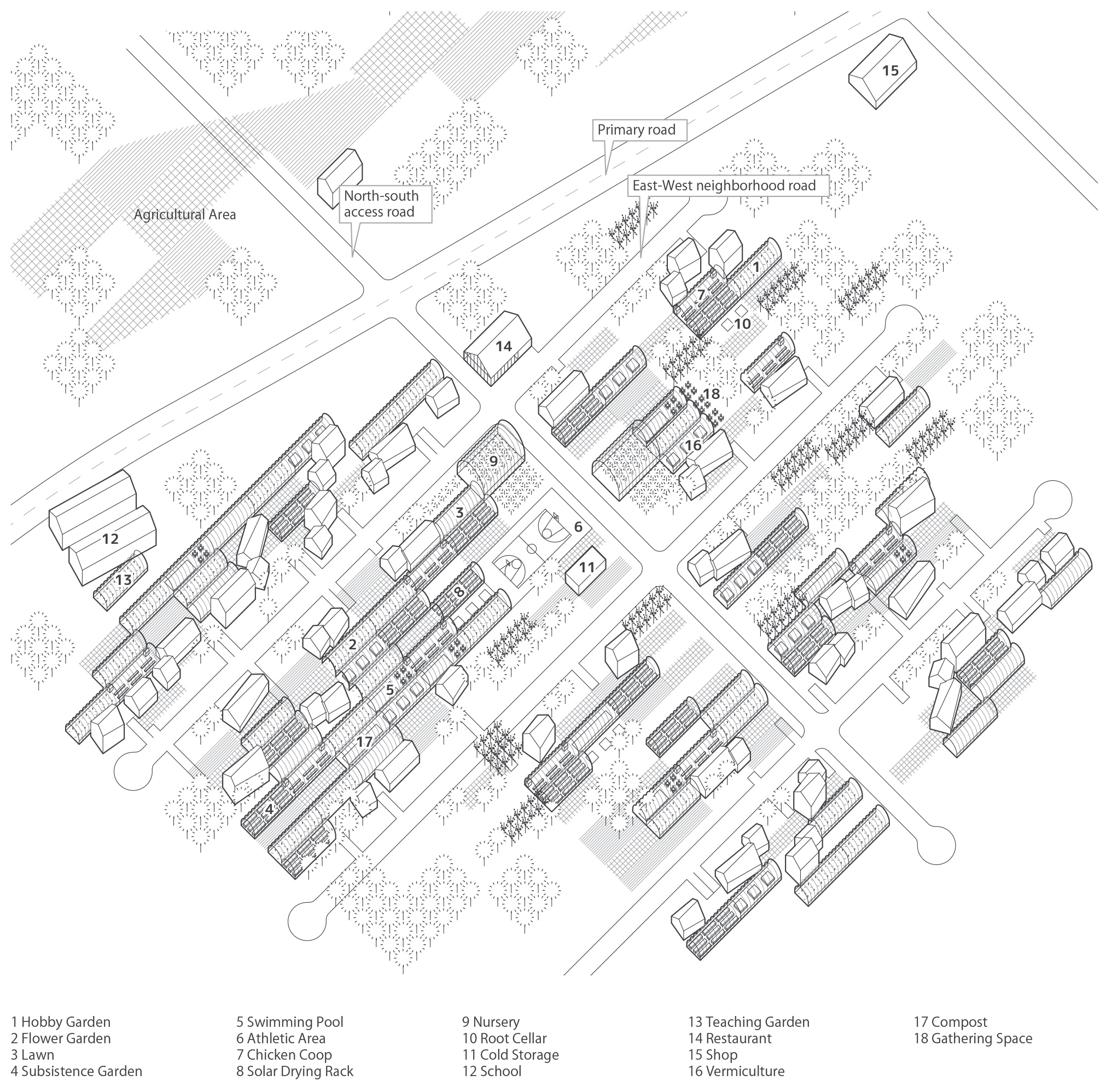
Community Building and Programmatic Diversification
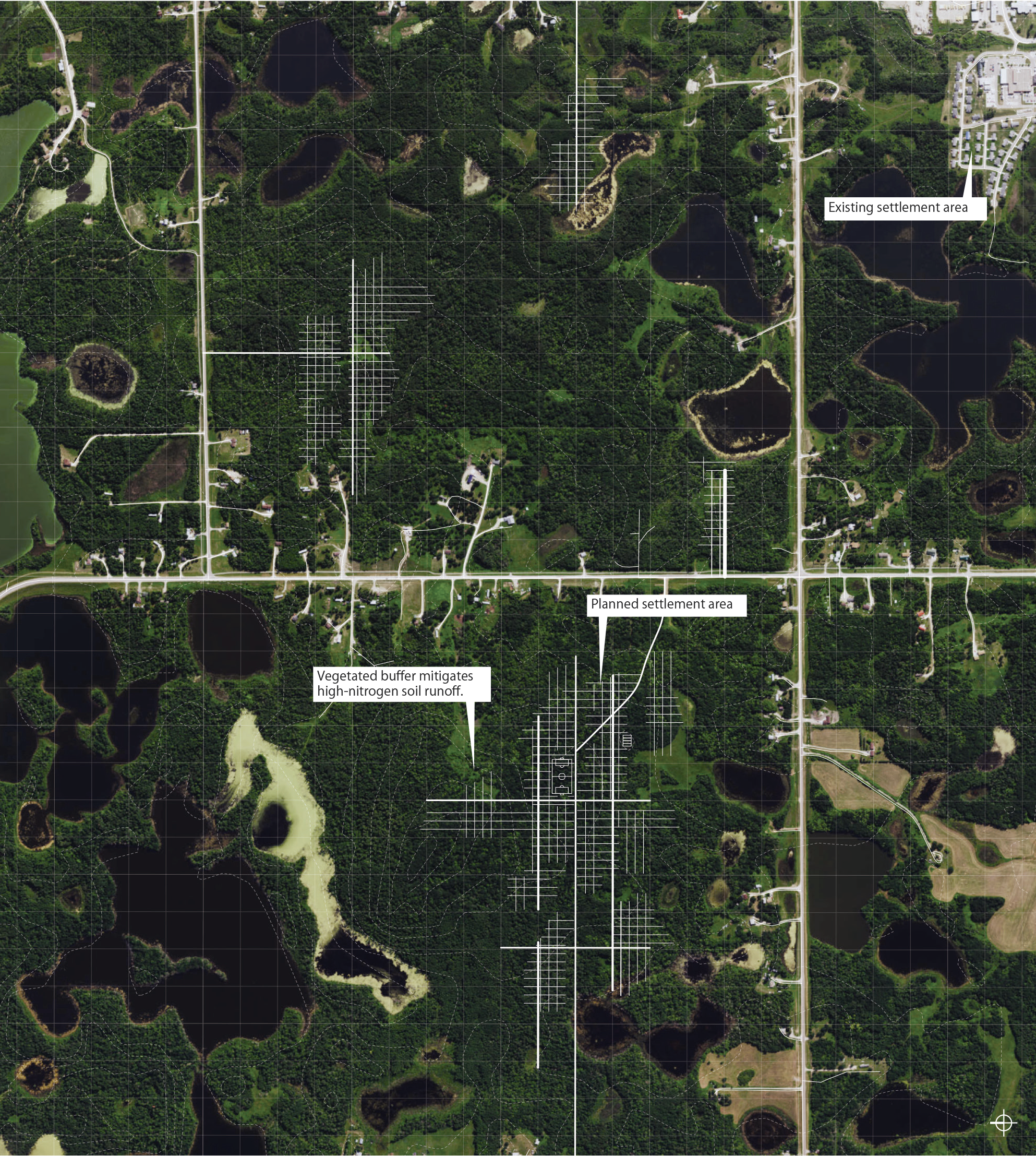
Settlement Plan

Suitability and Regional Plan Diagram